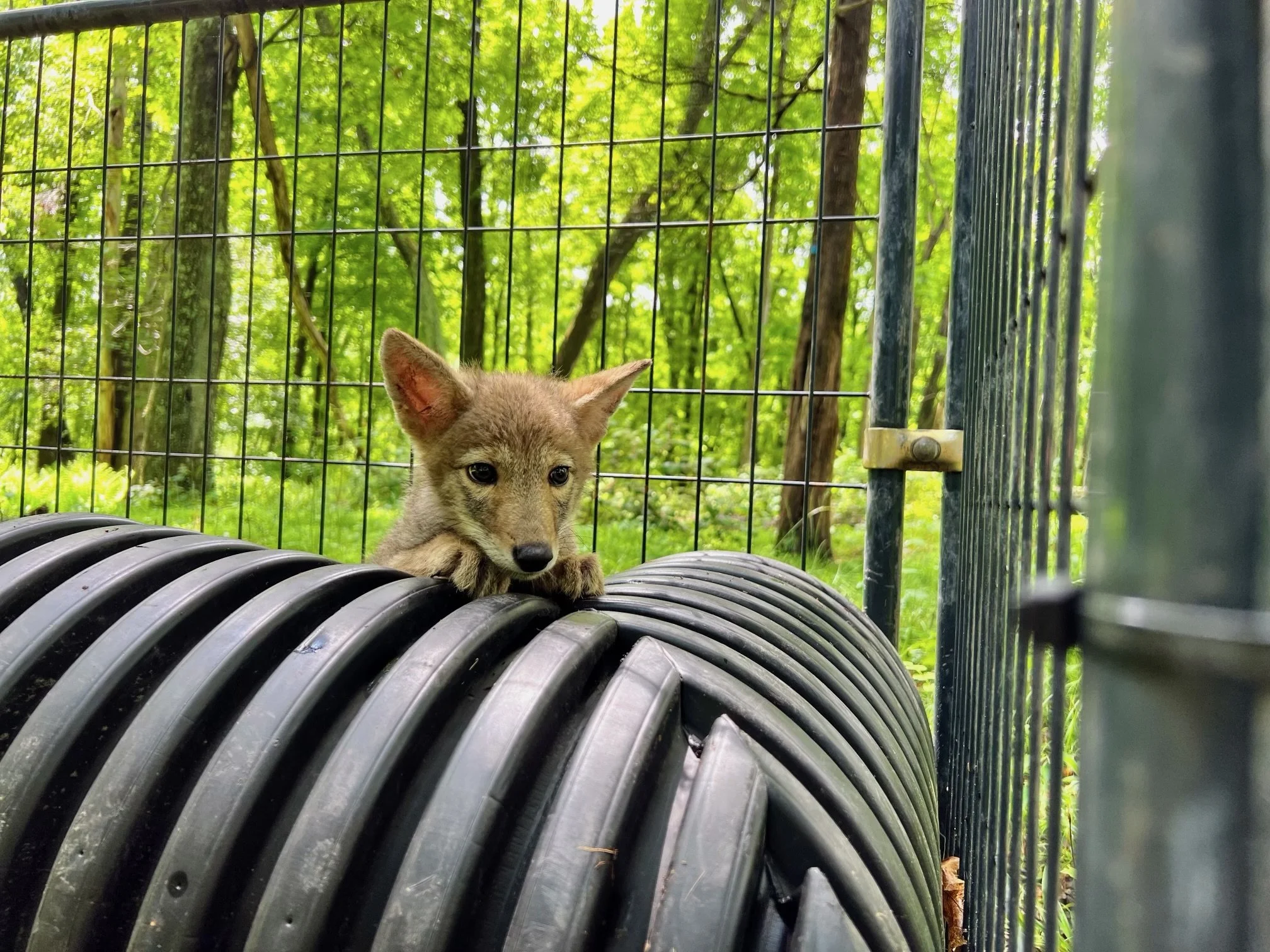
Coyotes are an important part of our local ecosystem, and they have every bit as much right to call Rockland County home as we do. As Rockland County continues to experience development, construction, and the loss and fragmentation of natural habitats, encounters between people and wildlife are becoming increasingly common. But we need to remember something important: Wildlife isn't moving into our neighborhoods. Our neighborhoods are continuing to move into their habitats.
Coyotes have been part of New York's landscape for generations. They are established throughout the state, including our suburban communities, and they are here to stay. They aren't temporary visitors, intruders, or animals that need to be removed simply because we happen to see them.
A few things you might not know:
Coyotes mate for life and typically live in family groups consisting of a breeding pair and their offspring.
They establish home ranges and remain in their territories throughout the year.
They are not strictly nocturnal. Although they are generally more active at night, seeing one during the day is not, by itself, a sign of illness or abnormal behavior.
Females typically give birth to litters of four to six pups in the spring.
Young coyotes eventually leave their family territories to establish territories of their own.
They communicate through vocalizations, including howling, yipping, and barking.
THEIR ROLE IN OUR ECOSYSTEM
Coyotes are more than just another animal living in our woods. They are an important part of maintaining a healthy and balanced ecosystem.
As opportunistic omnivores, coyotes eat a variety of foods depending on the season and what is available. Their diet can include:
Mice, rats, and other small rodents
Rabbits and groundhogs
Deer, including carrion
Raccoons
Birds and insects
Fruits, berries, and other plant materials
Why does this matter?
Natural rodent control: Coyotes help regulate populations of small mammals, including mice and rats. This is an important ecological service, particularly in areas where rodents are abundant.
Maintaining ecological balance: As predators, coyotes influence the populations and behavior of other animals within their ecosystems.
Scavenging: By consuming carrion, including animals killed on roadways, coyotes help remove animal remains from the environment.
Supporting biodiversity: Healthy ecosystems depend on complex relationships between predators, prey, plants, and other wildlife. Coyotes are one important part of that balance.
Removing predators from an ecosystem does not simply eliminate one species. It can disrupt relationships throughout the food web.
THEY HAVE ALWAYS BEEN PART OF OUR LANDSCAPE
There is a common misconception that coyotes are new to our neighborhoods or that their presence means something is wrong. The truth is that coyotes have been established in New York for decades, and are year-round residents. As development continues throughout Rockland County, natural habitats are increasingly fragmented by roads, housing, commercial properties, and other construction. Woodlands that once provided continuous habitat are divided into smaller sections. Animals must navigate around homes, cross roads, and adapt to the changing landscape.
And yet, they continue to survive.
We cannot continue developing land and expect the wildlife who depend on it to simply disappear. We cannot expect animals to understand property lines, neighborhood boundaries, or the human concept of what belongs in a particular space. Seeing a coyote in your yard, walking along a wooded trail, or passing through your neighborhood does not automatically mean there is a problem. It means a wild animal is moving through its home range.
We need to shift our perspective from asking, "How do we get rid of coyotes?" to asking, "How do we make our communities safer for people and wildlife?"
UNDERSTANDING COYOTE BEHAVIOR
Coyotes are naturally wary of people and generally prefer to avoid human interaction. However, when coyotes repeatedly encounter accessible food sources, such as unsecured garbage, outdoor pet food, or intentional feeding, they may become accustomed to human environments. This is called habituation. It is important that we do not encourage this behavior. Keeping coyotes wild and naturally wary of people is one of the most important parts of coexistence.
A coyote sighting is not necessarily a cause for concern.
Seeing a coyote during daylight hours is normal.
Seeing a coyote walking through your yard is normal.
Hearing coyotes howling at night is normal.
Seeing a coyote traveling through a neighborhood is normal.
Seeing a coyote from a distance while walking a trail is normal.
Coyotes may become more protective around their dens during pup-rearing season in the spring and early summer. They may also be more visible when young coyotes begin dispersing from their family territories.
HOW TO COEXIST WITH COYOTES
1. Never feed coyotes: Do not intentionally feed coyotes or leave food out for wildlife. Feeding can cause coyotes to associate people and residential areas with food.
2. Secure garbage and compost: Keep garbage in secure containers and avoid leaving food scraps accessible outdoors.
3. Bring pet food inside: Never leave dog or cat food outside overnight. Clean up any uneaten food.
4. Protect your pets: Keep cats indoors. Walk dogs on a leash, particularly around wooded areas, and supervise them when outdoors. Never allow pets to approach or chase coyotes.
5. Be mindful during pup-rearing season: During spring and early summer, give coyotes additional space around potential denning areas. Keep dogs close and do not approach dens or pups.
6. Never intentionally approach or corner a coyote: Allow wildlife an opportunity to move away. Never attempt to touch, feed, chase, or capture a coyote.
COYOTE HAZING: WHAT TO DO IF A COYOTE GETS TOO CLOSE
One of the most effective tools for encouraging safe coexistence is something called hazing. Project Coyote, recommends hazing as a non-lethal way to reinforce a coyote's natural wariness of people. Hazing is the process of using your presence, voice, and other non-harmful deterrents to discourage a coyote from approaching people or becoming comfortable in residential spaces. The goal is not to hurt the animal. The goal is to teach the animal to maintain a healthy distance from humans.
THE SMART METHOD
Project Coyote recommends the SMART approach:
S — STOP: Stand your ground. Maintain eye contact with the coyote. Do not run away. If you have a small dog, pick them up if it is safe to do so. Always leave the coyote an escape route.
M — MAKE YOURSELF LOOK BIG: Raise your arms above your head. Open your jacket, wave your arms, and make yourself appear as large as possible.
A — ALERT THE COYOTE: Use a loud, firm voice. Yell something like "GO AWAY, COYOTE!" Clap your hands, stomp your feet, or use a whistle or other noisemaker.
R — REPEAT AND REINFORCE: Continue hazing until the coyote moves away. Do not stop simply because the animal pauses or looks back. Consistency helps reinforce that approaching people is not comfortable or rewarding.
T — TEACH OTHERS: Share this information with your neighbors and community. Coyotes learn from repeated experiences. When different people consistently reinforce appropriate boundaries, coyotes are more likely to maintain their natural distance from humans.
Important: Hazing is intended for situations where a coyote is approaching, lingering too close, or showing concerning familiarity with people. You do not need to chase or harass a coyote that is simply passing through at a safe distance. Never approach a coyote to initiate hazing, corner it, or attempt to haze it toward a road. If you feel unsafe, move to a secure location.
COEXISTENCE IS OUR RESPONSIBILITY
At Rockland Wildlife, we understand that encountering wildlife can sometimes feel unfamiliar or uncomfortable, especially when an animal is living close to our homes. But we must remember that these animals are not choosing to invade our lives. They are trying to survive in a landscape that is changing around them. They deserve the opportunity to live wild and free, just as we deserve to feel safe in our communities. Those two things do not have to be mutually exclusive.